Quick answer
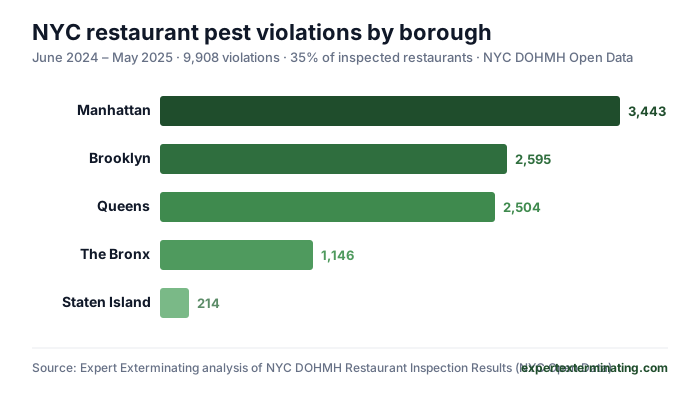
Across 17,844 NYC restaurants inspected by the Health Department between June 2024 and May 2025, 6,314 — more than 1 in 3 (35%) — were cited for evidence of mice, rats, roaches or filth flies, totalling 9,908 pest violations (NYC DOHMH Open Data). Mice are by far the most common restaurant pest (4,013 violations). ZIP 10019 (Midtown West / Hell's Kitchen) recorded the most pest violations of any neighborhood (210), and Manhattan led the boroughs (3,443) — though raw counts track restaurant density as much as pest pressure.
New York City’s Health Department inspected 17,844 restaurants in the 12 months from June 2024 to May 2025. 6,314 of them — more than one in three — were cited for evidence of mice, rats, roaches or filth flies, across 9,908 pest violations in total. We mapped every one of those violations by borough, ZIP code and pest type, using the City’s own public inspection data, to answer a question every New York diner (and every restaurant owner) wonders about: where is the city’s restaurant pest problem worst?
The borough picture
Manhattan records the most restaurant pest violations of any borough — but that’s also where the most restaurants are, so read this as a map of where the violations are, not a like-for-like infestation rate.
| Rank | Borough | Pest violations | Share of NYC | Restaurants cited |
|---|---|---|---|---|
| 1 | Manhattan | 3,443 | 34.7% | 2,238 |
| 2 | Brooklyn | 2,595 | 26.2% | 1,668 |
| 3 | Queens | 2,504 | 25.3% | 1,561 |
| 4 | The Bronx | 1,146 | 11.6% | 679 |
| 5 | Staten Island | 214 | 2.2% | 164 |
Mice are the #1 restaurant pest
Cockroaches get the headlines, but it’s mice that NYC restaurant inspectors cite most often — more than twice as often as roaches, and four times more than rats.
| Rank | Pest | Violations | Share |
|---|---|---|---|
| 1 | Mice | 4,013 | 40.5% |
| 2 | Filth flies (FRSA) | 3,436 | 34.7% |
| 3 | Roaches | 1,547 | 15.6% |
| 4 | Rats | 912 | 9.2% |
“Filth flies” (FRSA — food, refuse and sewage-associated flies: house flies, fruit flies, drain flies and Phorid flies) are the surprise runner-up — a direct signal of drain, grease-trap and refuse problems behind the scenes.
The 20 worst ZIP codes for restaurant pest violations
The hotspots cluster in Manhattan’s dense restaurant corridors — Midtown, the East Village, the Lower East Side and Chinatown — with Sunset Park, Flushing, Jackson Heights and Astoria carrying the outer-borough load.
| Rank | Neighborhood | ZIP | Borough | Pest violations |
|---|---|---|---|---|
| 1 | Midtown West / Hell’s Kitchen | 10019 | Manhattan | 210 |
| 2 | East Village / Union Square | 10003 | Manhattan | 199 |
| 3 | Lower East Side / Chinatown | 10002 | Manhattan | 196 |
| 4 | Chinatown / Tribeca / SoHo | 10013 | Manhattan | 176 |
| 5 | Chelsea / Hudson Yards | 10001 | Manhattan | 172 |
| 6 | Sunset Park | 11220 | Brooklyn | 158 |
| 7 | Murray Hill / Kips Bay | 10016 | Manhattan | 157 |
| 8 | Chelsea / Flatiron | 10011 | Manhattan | 155 |
| 9 | NoHo / SoHo / Greenwich Village | 10012 | Manhattan | 154 |
| 10 | Flushing | 11354 | Queens | 150 |
| 11 | Jackson Heights | 11372 | Queens | 137 |
| 12 | Times Square / Theater District | 10036 | Manhattan | 136 |
| 13 | West Village | 10014 | Manhattan | 131 |
| 14 | Fordham / Belmont | 10458 | The Bronx | 128 |
| 15 | Astoria | 11103 | Queens | 127 |
| 16 | Williamsburg | 11211 | Brooklyn | 127 |
| 17 | Park Slope | 11215 | Brooklyn | 126 |
| 18 | Midtown East / Sutton Place | 10022 | Manhattan | 125 |
| 19 | Brooklyn Heights / Downtown Brooklyn | 11201 | Brooklyn | 125 |
| 20 | Jamaica | 11432 | Queens | 125 |
Why these neighborhoods?
The restaurant-pest hotspots share the same conditions that make these blocks tough on home dwellers too:
- Sheer restaurant density. Midtown, the Village and Chinatown pack thousands of kitchens into a few square blocks, so even an average violation rate produces a high violation count. More kitchens, more shared walls, more chances for pests to move building to building.
- Aging buildings and shared infrastructure. Pre-war commercial buildings with common basements, party walls and old plumbing let mice and roaches travel between tenants — one untreated kitchen can re-seed its neighbors.
- Grease, refuse and drains. Filth-fly violations track directly to grease traps, floor drains and refuse storage — back-of-house systems that are hard to keep clean at high volume.
- Constant food and waste. Round-the-clock dining corridors generate continuous trash on the curb, which feeds rat and mouse pressure that pushes indoors.
Methodology & honest caveat
We pulled every inspection record whose violation description cites evidence of rats, mice, roaches or filth (FRSA) flies from the DOHMH New York City Restaurant Inspection Results dataset (NYC Open Data) for June 1, 2024 – May 31, 2025, then aggregated by borough, ZIP code and pest type. Data pulled June 16, 2026.
Important: this ranks neighborhoods by cited violations, which is not the same as the absolute number of pests — or the rate per restaurant. A ZIP with thousands of restaurants will record more violations than a ZIP with a few dozen, even at the same infestation rate, so the raw ZIP and borough counts partly reflect restaurant density. The most density-neutral figure here is the citywide rate: about 35% of all inspected restaurants were cited for at least one pest. We filter on the violation description text rather than the violation code, because DOHMH has reused codes across different violation types over the years; matching on the wording (“evidence of mice”, “live roaches”, “filth flies”) is the reliable way to isolate genuine pest citations.
Use this data (free to cite, embed or download)
Journalists, researchers and bloggers are welcome to use this — it’s public data, openly presented. A link back is appreciated.
Download the full dataset (CSV): nyc-restaurant-pest-violations-2025.csv — boroughs, pest types and top-20 ZIPs.
Cite it as:
Analysis of NYC DOHMH Restaurant Inspection Results (NYC Open Data), pest violations, June 2024–May 2025. https://expertexterminating.com/guides/nyc-restaurant-pest-violations/
Embed the chart (copy-paste — it links back to the full data):
<a href="https://expertexterminating.com/guides/nyc-restaurant-pest-violations/">
  <img src="https://expertexterminating.com/images/nyc-restaurant-pest-boroughs-2025.svg"
       alt="NYC restaurant pest violations by borough, 2024–2025" width="700" style="max-width:100%;height:auto" />
</a>
Run a restaurant or commercial kitchen? Here’s what actually clears a violation
A pest citation pushes points toward a B or C grade — and a visible grade card is a revenue issue. The fix that holds up at re-inspection is exclusion and sanitation, not a one-off spray:
- Find and seal entry points. Mice get through a gap the width of a pencil — close gaps around pipes, conduit, doors and the foundation. Mice are the #1 cited restaurant pest for a reason.
- Cut off food, water and harborage. Tight refuse storage, clean grease traps and floor drains (the FRSA-fly source), no standing water, and clutter cleared from back-of-house.
- Put a documented program in place. Inspectors look for a pest-management paper trail. A scheduled commercial pest control program with service records is both the durable fix and the documentation that protects your grade.
- Get a professional inspection. A licensed exterminator finds the entry points and harborage you’ll miss, sets up safe monitoring, and proofs the premises. A licensed exterminator provides restaurant and commercial pest control across all five boroughs.
Curious how the home side compares? See our companion studies on the rattiest NYC neighborhoods and NYC’s bed-bug hotspots — same open-data approach, residential angle.