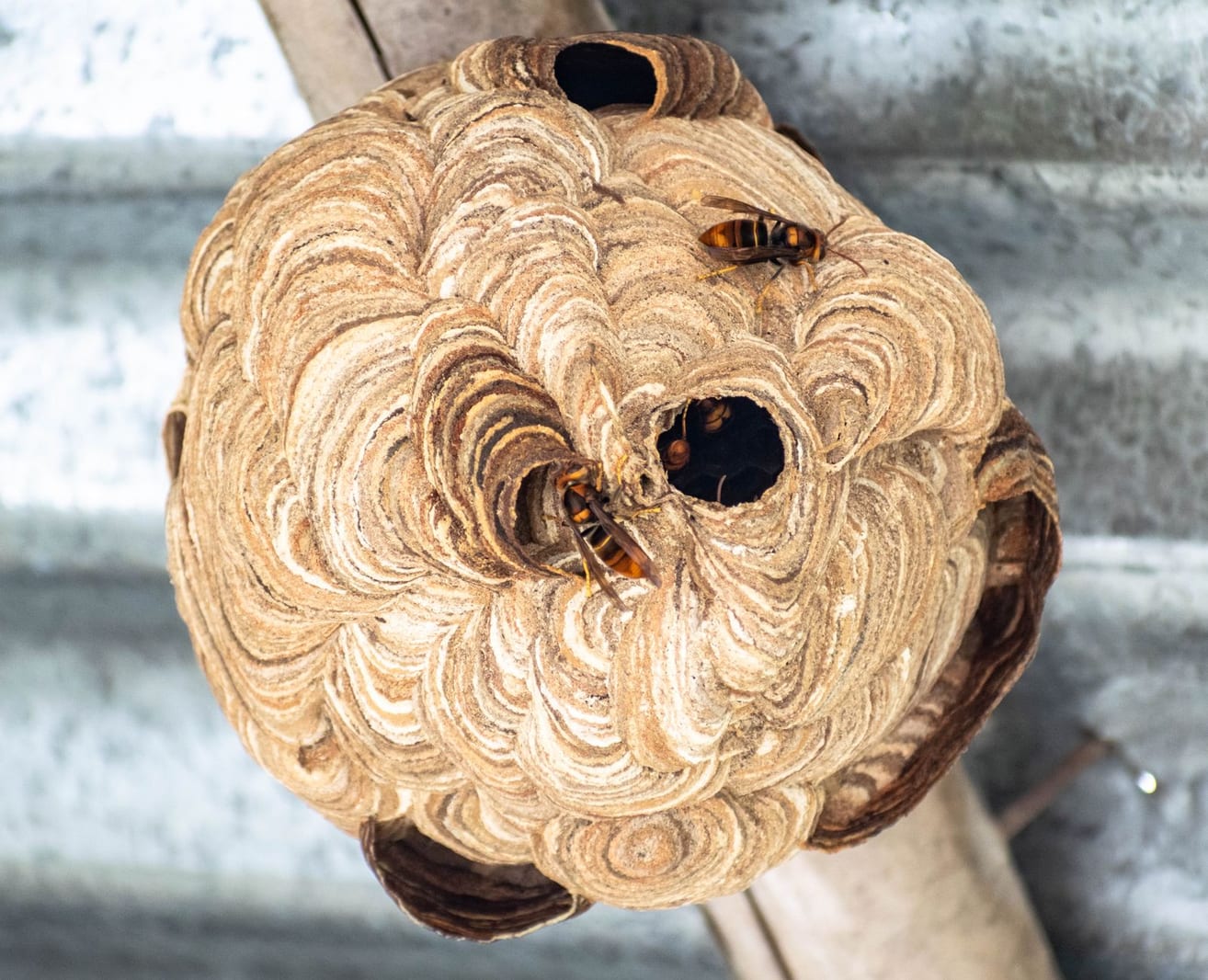
Not every stinging insect on a Brooklyn property calls for the same response. Wasps and hornets build paper nests in eaves, gutters, shed corners, and yard structures, and they'll defend that nest aggressively — multiple stings from a single encounter are common, and for anyone with a known allergy, a nest close to a doorway or garden path is a real medical risk. Bees are a different case: honeybee colonies are ecologically beneficial, and where a swarm or hive can be safely relocated rather than exterminated, that's the preferred outcome for a licensed technician.
Our process starts with correct identification, because treatment for a ground-nesting yellowjacket colony is not the same as treatment for hornets under a roofline or a honeybee swarm that's settled in a tree. We inspect the nest location, assess access and proximity to where people actually walk, sit, or garden, and choose a method that matches the species and the site — not a one-size-fits-all spray.
Brownstone backyards and gardens across Park Slope and Carroll Gardens are classic nest sites: wood fencing, shed eaves, dense plantings, and rarely-disturbed corners give wasps and hornets exactly the shelter they look for each season. If you're seeing repeated activity in the same yard corner or eave, that's usually a nest nearby, not just foraging insects passing through.
Stinging insects around a NYC home: how do you tell them apart and remove them safely?
UC IPM notes that a yellowjacket nest is enclosed by a paper envelope with a single entrance hole and is often built in protected cavities such as voids in walls and ceilings, whereas a paper wasp nest hangs like an open umbrella from a stalk with its cells visible from beneath, typically under eaves or in attics — so the nest shape tells you which insect you are dealing with. (UC IPM — Yellowjackets and Other Social Wasps)
Per UC IPM, only about one to two people per 1,000 are allergic or hypersensitive to bee or wasp stings, but for those people a sting can trigger life-threatening reactions such as shock, dizziness, difficulty breathing or throat swelling that blocks the airway — all of which require immediate medical care. For most people stings are painful rather than dangerous. (UC IPM — Bee and Wasp Stings)
CDC/NIOSH advises that while most insect stings cause only minor discomfort, some produce severe allergic reactions that require immediate medical care and can be fatal, and that anyone with a history of severe reactions should carry an epinephrine autoinjector and wear medical-ID jewellery. This is why a nest by a doorway or high-traffic area is treated as urgent. (CDC/NIOSH — Insects and Scorpions)
Not every stinging insect should be exterminated. Penn State Extension explains that honey bees play a major role in pollinating agricultural crops, and that a honey bee swarm is docile enough for a beekeeper to shake into a box and relocate to a hive — which is why a reputable service identifies honey bees and arranges relocation rather than killing them. (Penn State Extension — Honey Bee Management)
Yellowjacket vs paper wasp vs hornet vs honey bee
| Feature | Yellowjacket | Paper wasp | Hornet | Honey bee |
|---|---|---|---|---|
| Body | Short waist, bright black-and-yellow, near-hairless | Slender body, long dangling legs, distinct waist | Larger social wasp, black with white/pale markings | Rounder, hairy, less brightly striped |
| Nest | Paper envelope, single entrance; ground or wall/ceiling voids | Open umbrella of visible cells on a stalk, under eaves | Large enclosed grey paper envelope, often aerial | Wax comb; a colony in hives or wall voids |
| Temperament | Defends nest vigorously when disturbed | Much less defensive; rarely stings humans | Defends nest aggressively if disturbed | Unlikely to sting unless trapped or stepped on |
| Right response | Treat/remove nest; pro PPE for in-wall voids | Often leave alone unless by a doorway | Treat/remove nest with professional care | Relocate via a beekeeper — do not exterminate |
Signs you have a stinging insect removal problem
- Visible paper nest under eaves, in a shed, or in a fence corner
- Repeated wasp or hornet activity concentrated in one area of the yard
- Ground-level holes with insects entering and exiting (possible yellowjacket nest)
- A honeybee swarm clustered on a branch, wall, or structure
- Increased stinging-insect activity near garbage areas or garden plantings in warmer months
Why Park Slope sees this
Big Apple Pest Control operates under NY Pesticide Business Licence #15739, with Mike Jacoby as the licensed exterminator behind the brand. Stinging-insect jobs get treated with the same licensed-professional standard as anything else on the roster — correct species ID first, then a method that fits the site, not a reflexive spray-everything approach.
Park Slope and Carroll Gardens brownstones, with their shared backyard gardens and wood fencing, see this kind of nesting pressure every warm season. Crown Heights and Bedford-Stuyvesant row houses with similar yard layouts show the same pattern. If a nest is tucked into an eave or shed where it's easy to walk past without noticing until activity picks up, that's worth a call before someone gets stung.