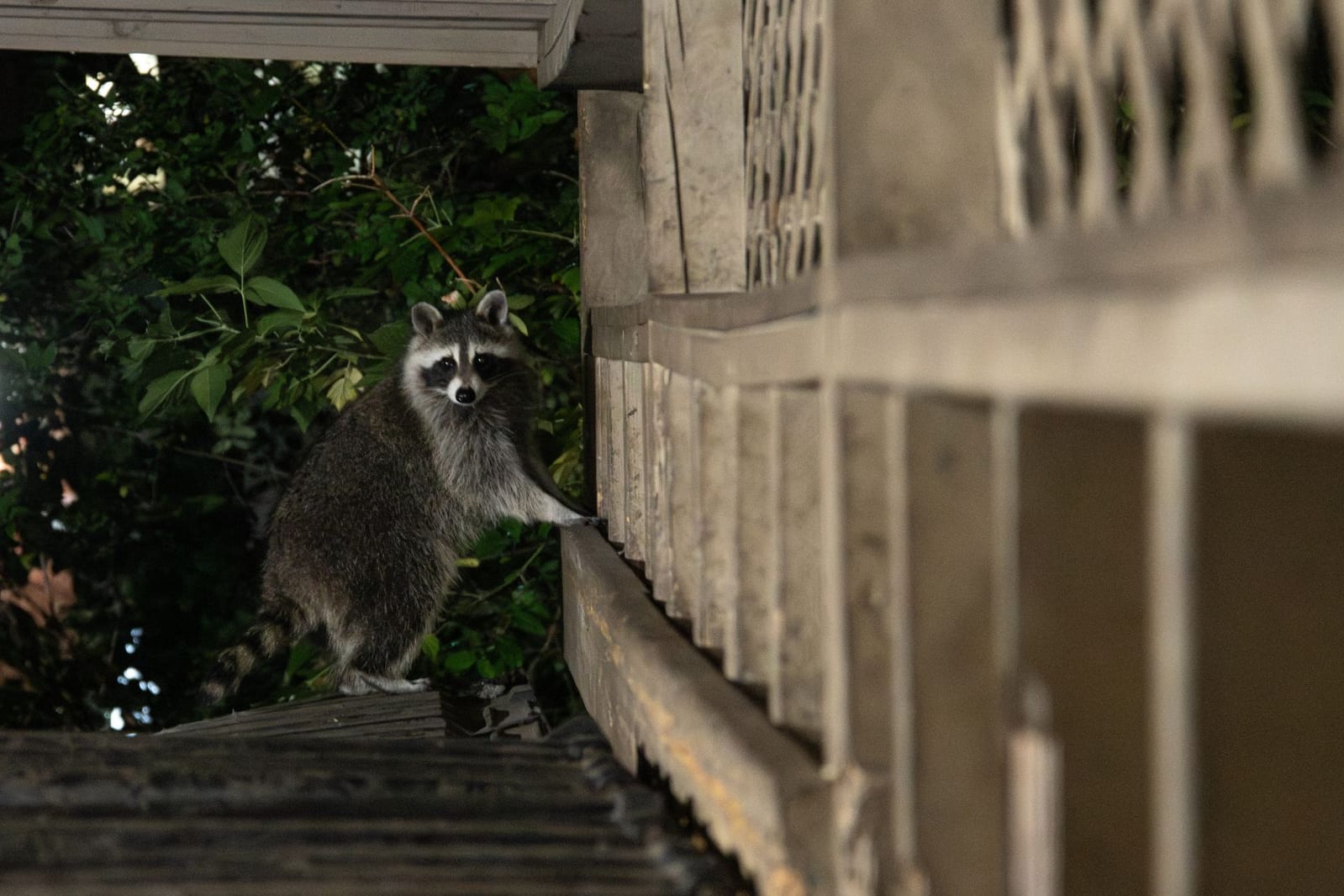
Raccoons and squirrels denning in a NYC building are a licensing issue as much as a pest issue — New York State regulates who can legally trap and handle nuisance wildlife, and a homeowner pulling an animal out of a chimney or soffit themselves risks both a bite and a botched job that leaves the entry point open. Squirrels favor attic gaps and roof eaves; raccoons go for chimneys, crawlspaces, and sheds, especially where a yard backs onto another yard or a park.
The tell in most cases isn't the animal itself but the noise and damage pattern — scratching in a wall cavity at dusk, torn soffit vents, or a chimney cap knocked loose. Female raccoons in particular will den in a chimney to raise young, which changes the approach: exclusion has to wait until the young are mobile enough to leave with the mother rather than trapping her away from a dependent litter.
Under licence #15739, our technicians identify the species and entry point, exclude humanely, and seal the access point so the same animal — or the next one drawn to an open vent — can't get back in.
Getting wildlife out of an attic safely — what NYC homeowners should know
Per the CDC, raccoons and bats are the primary rabies-reservoir species in the eastern US — together they account for the majority of animals that expose Americans to rabies, and raccoons are an established reservoir along the entire Eastern seaboard. That is why grounded or daytime-active nuisance wildlife should never be handled directly and is a job for a trained operator. (CDC — Rabies in the United States)
The CDC notes raccoon roundworm (Baylisascaris) lives in raccoons and is shed in their droppings; people are infected by accidentally swallowing eggs from contaminated soil or surfaces, and although rare, infection can be severe when larvae invade the eye, organs or brain. So a raccoon latrine in an attic needs careful clean-up, not just animal removal. (CDC — About Raccoon Roundworm)
Penn State Extension stresses that trapping or evicting a nuisance animal only works long-term when paired with exclusion — sealing every foundation and structural opening — because an open structure is simply reoccupied by new animals. Removing denning sites and sealing entries is the durable fix, not removal alone. (Penn State Extension — Nuisance Wildlife Solutions)
Penn State Extension warns that bats must never be sealed out during the maternity season (late May to mid-July), because flightless pups would be trapped and die inside. Humane exclusion uses one-way devices timed for spring before bats arrive or late summer and fall after pups can fly, then entry points are permanently sealed. (Penn State Extension — Timing for Excluding Bats)
How much does wildlife & squirrel removal cost in NYC?
$150–$600
Squirrel removal: $200–$600 (typical $250–$450, avg ~$300). Raccoon removal: $300–$450 avg, or $150–$300 per animal for trap-and-release. Exclusion vent installation: $300–$450 each. One-way mesh exclusion barrier: $10–$25/linear foot.
| Squirrel removal | $200–$600 one-time |
| Raccoon removal | $150–$450 one-time |
| Exclusion vent installation | $300–$450 per vent |
US national figure — NYC typically runs higher.
Market range — not our quote
This is a market range synthesised from published cost guides — not a quote from this provider. The actual price depends on an in-person or photo-based inspection.
US national — NYC typically higher. No NYC-specific wildlife-removal cost guide found despite NYC's well-documented raccoon/squirrel-in-building problem — a genuine gap versus the bed bug/rat/roach guides.
What drives the price
- Species
- Number of animals
- Location (open yard vs attic/wall void)
- Cleanup/repair needed after removal (droppings, insulation, entry-point damage)
Signs you have a wildlife removal problem
- Scratching or thumping in the attic, wall cavity, or chimney, usually at dusk or dawn
- Torn or pushed-out soffit vents, roof flashing, or chimney caps
- Raccoon droppings (dark, tubular) in a yard, deck, or attic corner
- A knocked-over trash can or dug-up garden bed on a recurring basis
- Visible den entry — a gap under a shed, deck, or loose siding
Why Park Slope sees this
This is a real pressure point in Park Slope and Carroll Gardens, where a run of connected brownstone backyards backing onto each other — and onto Prospect Park in Park Slope's case — gives raccoons and squirrels an easy corridor between denning spots and food. A loose chimney cap on one block can end up housing a family of raccoons that's been working its way down the row.
Queens Village and other more detached, yard-heavy pockets of Queens see it differently — sheds, crawlspaces, and roof eaves on standalone houses rather than shared party walls. Flatbush falls somewhere in between, with both rowhouse cornices and freestanding homes in play. Every removal runs under licence #15739 and New York State's nuisance wildlife handling rules, which is why we exclude and seal rather than just trap and relocate.