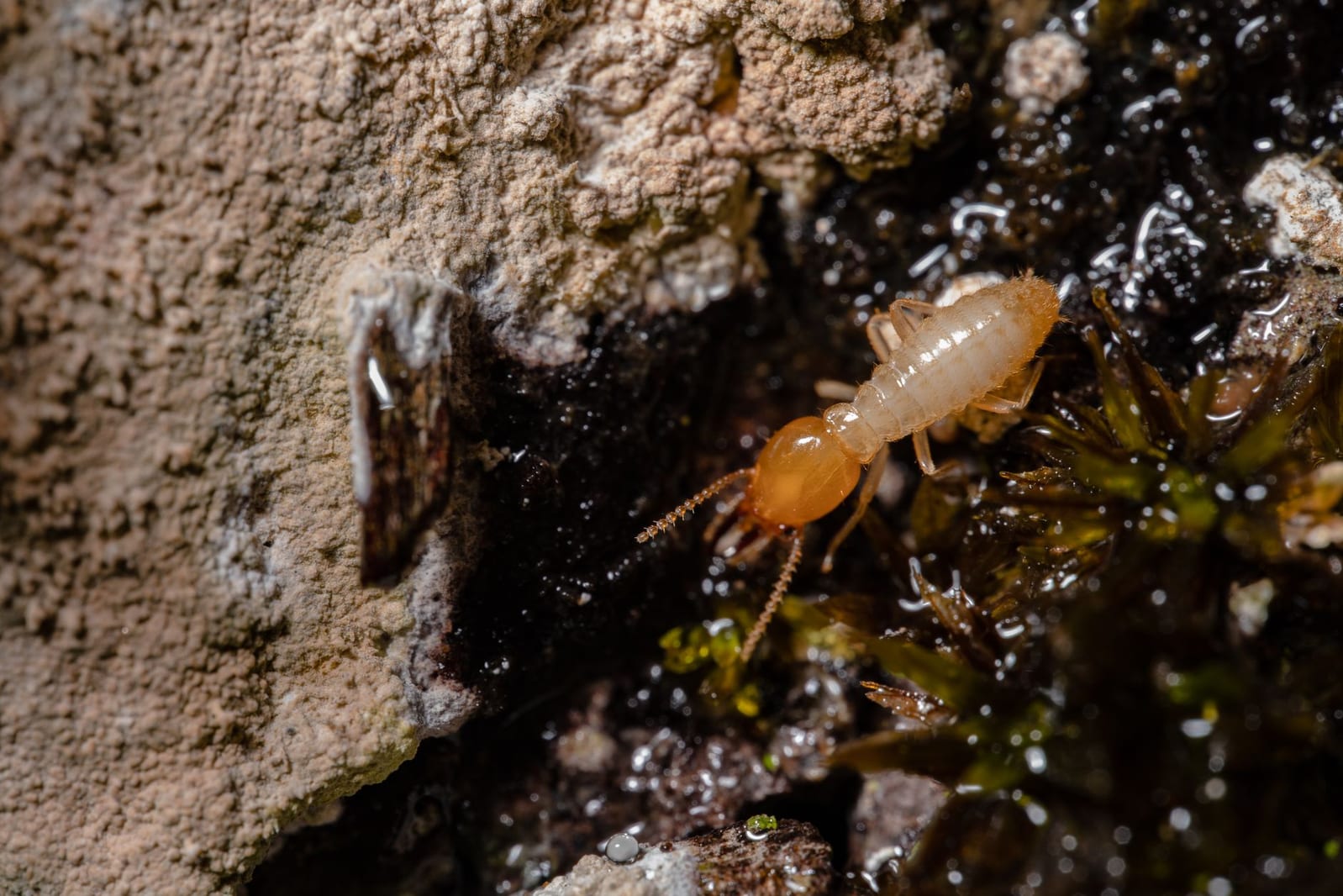
Subterranean termites are a real and well-documented pressure in New York City's older wood-frame housing stock, and Brooklyn row houses with wood framing and basement or foundation-level wood contact are a common risk profile. These termites live in underground colonies and travel into structures through soil contact with foundations, wood-to-ground contact, or small cracks — damage often develops out of sight before it's visually obvious.
Spring is swarm season for subterranean termites in this region — a well-established seasonal pattern where winged reproductive termites emerge from an established colony to start new ones. Seeing a swarm of winged insects near your foundation, especially in spring, or discarded wings near windowsills, is one of the more reliable early indicators that a colony is active near the structure.
Termite inspection starts with checking the areas most exposed to soil contact — foundation walls, basement wood framing, crawlspaces, and any wood-to-ground contact points around the property. Confirmed activity determines the treatment approach; a home with no evidence of activity gets an honest inspection report, not a treatment sale.
Termites in New York City: what eastern subterranean termites are and how they're really controlled
The species threatening Northeast building stock is the eastern subterranean termite. Penn State Extension notes these termites often damage structural timbers in buildings, but the damage is slow: when it becomes evident it is usually the result of years of infestation, and termite problems generally appear only some years after construction — usually 10 years or more. (Penn State Extension — Eastern Subterranean Termites)
Subterranean termites live in the soil and need that moisture, reaching wood through mud "shelter tubes." Penn State Extension explains the termites build these earth-coloured tubes as a protected runway from the earth to the wood they feed on, that wood embedded in earth or in concrete cellar floors is especially susceptible, and that winged swarmers usually emerge between February and June. (Penn State Extension — Eastern Subterranean Termites)
Winged termite swarmers are routinely mistaken for flying ants. Penn State Extension gives the field test: an ant has a narrow, wasp-like waist while a termite has a broad waist; termite antennae are straight where an ant's are L-shaped; and a termite's four wings are all of equal length, unlike an ant's unequal fore and hind wings. Correct identification decides whether you have a termite problem at all. (Penn State Extension — Eastern Subterranean Termites)
There is no one-spray fix. The US EPA states the most common technique for treating termite infestations is the soil-applied barrier treatment, while newer bait systems rely on cellulose baits containing a slow-acting insecticide. The EPA cautions that termiticide application can only be properly performed by a trained pest-management professional, because many termiticides are highly toxic and demand label-precise equipment and method. (US EPA — Termites: How to Identify and Control Them)
Liquid soil barrier vs in-ground bait stations
| Liquid termiticide barrier | In-ground bait stations | |
|---|---|---|
| How it works | A continuous treated soil zone applied by professionals through trenching, drilling or rodding around the structure (UC IPM) | Cellulose bait stations set in the ground; foraging termites feed and carry the slow-acting active ingredient back toward the colony (US EPA) |
| Speed | Establishes a protective treated zone once applied | UC IPM: bait systems may take several months or even years to control the problem |
| Ongoing commitment | Periodic re-inspection; barrier integrity must be maintained | UC IPM: must be followed up with constant monitoring |
| Who should do it | UC IPM: methods are for professional use only | Professional install + monitoring; EPA: application only by a trained professional |
How much does termite control & inspection cost in NYC?
$75–$8,000
Inspection: $75–$325 (avg ~$100; many companies offer inspections free). Standard treatment: $230–$1,000 (avg ~$600). Extensive infestation/fumigation: $1,500–$8,000. Annual termite bond/warranty: $200–$400/year.
| Inspection | $75–$325 one-time |
| Standard treatment | $230–$1,000 one-time |
| Extensive infestation / fumigation | $1,500–$8,000 one-time |
| Annual bond / warranty | $200–$400 per year |
US national figure — NYC typically runs higher.
Market range — not our quote
This is a market range synthesised from published cost guides — not a quote from this provider. The actual price depends on an in-person or photo-based inspection.
US national — NYC typically higher. No NYC-specific termite pricing found; NYC's older/pre-war building stock and closely-spaced structures are plausible cost drivers but this is inference, not a sourced NYC figure — not presented as verified.
What drives the price
- Inspection alone vs bundled with treatment quote
- Treatment method (spot/localized vs whole-structure fumigation)
- Severity/extent of colony
- Ongoing bond/warranty vs one-time treatment only
Signs you have a termite control problem
- Winged swarmers near foundations or windows, especially in spring
- Discarded wings on windowsills or near foundation walls
- Mud tubes on foundation walls or in basements or crawlspaces
- Wood that sounds hollow when tapped, or shows soft or damaged texture
- Wood-to-ground contact points around the property (deck posts, wood siding touching soil)
Why Park Slope sees this
Under NY Pesticide Business Licence #15739, Mike Jacoby and Big Apple Pest Control inspect for subterranean termite activity across Park Slope, Carroll Gardens, and Flatbush — areas with a substantial share of older wood-frame row houses where foundation and basement wood contact is common.
Row houses in Park Slope and Carroll Gardens, many built with wood framing and basements that predate current moisture-barrier standards, carry a real termite risk profile that newer construction generally doesn't share to the same degree. If your property has wood-to-ground contact — an older deck, wood siding close to grade, or basement framing near an exterior wall — that's a genuine access point worth having inspected, particularly heading into spring swarm season.