Wildlife removal in Harlem: what to know
Harlem's housing is dominated by pre-war apartment buildings, historic brownstones and walk-ups — handsome buildings with deep baseboard gaps, shared wall voids and aging plumbing that let rodents and cockroaches travel freely between units.
The dense restaurant and retail corridor along 125th Street and Lenox Avenue creates constant food-source pressure that feeds rodent and roach populations into the surrounding residential blocks.
Brownstone conversions are especially prone to bed bug spread through shared walls and hallways, and to 'water bugs' rising through old shared plumbing from basements.
Harlem's green edges — Marcus Garvey Park, St. Nicholas Park and Morningside Park — drive the warm-season pressure residents search for most: ants foraging indoors from spring through autumn, spiders moving in around old window frames and basements, and mosquitoes breeding in standing water after summer rain. These are common in ground-floor, garden and brownstone-rear apartments backing onto the parks.
How much does wildlife & squirrel removal cost in Harlem?
$150–$600
Squirrel removal: $200–$600 (typical $250–$450, avg ~$300). Raccoon removal: $300–$450 avg, or $150–$300 per animal for trap-and-release. Exclusion vent installation: $300–$450 each. One-way mesh exclusion barrier: $10–$25/linear foot.
| Squirrel removal | $200–$600 one-time |
| Raccoon removal | $150–$450 one-time |
| Exclusion vent installation | $300–$450 per vent |
US national figure — NYC typically runs higher.
NYC pest-control pricing tends to run higher in Manhattan than in Brooklyn or Queens — tier-2 NYC industry sources cite roughly a 10–20% premium, attributed to building-access logistics (walk-ups, elevators, doorman/board approval) and labour costs. This is directional signal from industry blogs, not an independently verified figure — confirm with a quote for your specific building.
Market range — not our quote
This is a market range synthesised from published cost guides — not a quote from this provider. The actual price depends on an in-person or photo-based inspection.
US national — NYC typically higher. No NYC-specific wildlife-removal cost guide found despite NYC's well-documented raccoon/squirrel-in-building problem — a genuine gap versus the bed bug/rat/roach guides.
What drives the price
- Species
- Number of animals
- Location (open yard vs attic/wall void)
- Cleanup/repair needed after removal (droppings, insulation, entry-point damage)
Signs you need wildlife removal
- Scratching or thumping in the attic, wall cavity, or chimney, usually at dusk or dawn
- Torn or pushed-out soffit vents, roof flashing, or chimney caps
- Raccoon droppings (dark, tubular) in a yard, deck, or attic corner
- A knocked-over trash can or dug-up garden bed on a recurring basis
- Visible den entry — a gap under a shed, deck, or loose siding
How we treat wildlife removal in Harlem
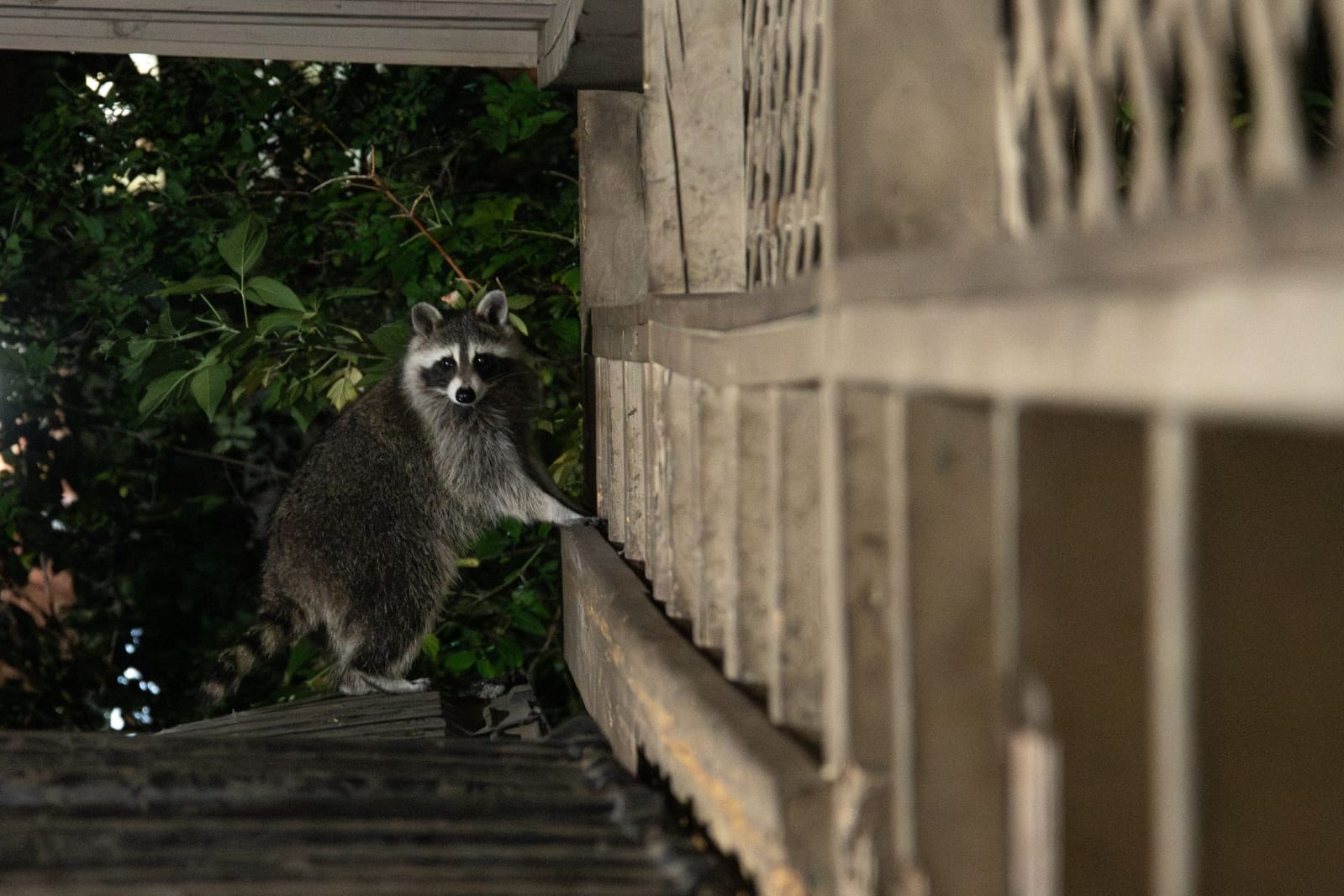
Raccoons and squirrels denning in a NYC building are a licensing issue as much as a pest issue — New York State regulates who can legally trap and handle nuisance wildlife, and a homeowner pulling an animal out of a chimney or soffit themselves risks both a bite and a botched job that leaves the entry point open. Squirrels favor attic gaps and roof eaves; raccoons go for chimneys, crawlspaces, and sheds, especially where a yard backs onto another yard or a park.
The tell in most cases isn't the animal itself but the noise and damage pattern — scratching in a wall cavity at dusk, torn soffit vents, or a chimney cap knocked loose. Female raccoons in particular will den in a chimney to raise young, which changes the approach: exclusion has to wait until the young are mobile enough to leave with the mother rather than trapping her away from a dependent litter.
Local landmarks & coverage
We serve all of Harlem and the surrounding Manhattan area — including Apollo Theater, 125th Street, Marcus Garvey Park, St. Nicholas Park, Morningside Park, Striver's Row, Lenox Avenue — across ZIP codes 10026, 10027, 10030, 10037, 10039.